
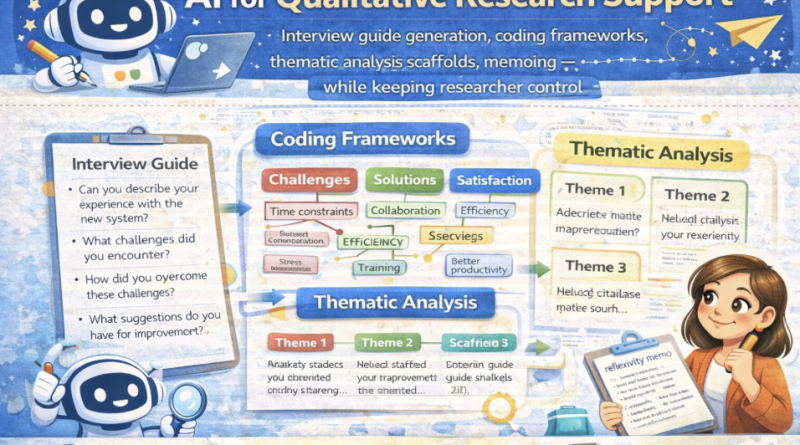
AI for Qualitative research

AI for Qualitative Research
Use AI to support interview guide design, coding frameworks, thematic analysis scaffolds, and memo writing— while keeping researcher control, transparency, and ethics. Includes a hands-on analysis lab and an end-of-lesson problem-solving task.
Mic: Off
Tip: For best voice options, use Chrome/Edge. If voices don’t appear yet, click once on the page and wait 2–3 seconds.
1) Outcomes
By the end, you can…
- Generate and refine an interview guide aligned to a research question.
- Build a coding framework (a priori + inductive codes) with clear definitions.
- Create a thematic analysis scaffold (codes → categories → themes).
- Write analytic memos that document decisions and reflexivity.
- Apply researcher control: transparency, audit trail, and ethical safeguards.
Researcher control rules
- AI suggests; you decide. Never accept codes/themes uncritically.
- Keep an audit trail: prompts, versions, decisions, and rationale.
- Protect confidentiality: de-identify transcripts before sharing.
- Check interpretive bias: use negative cases and alternative explanations.
Principle: AI is best used for structure (scaffolds, checklists, prompts), not for final interpretation.
2) Conversation (Qual Research Coach)
Practice a disciplined workflow: research question → sampling → interview guide → coding plan → memoing → trustworthiness checks.
Tip: A strong qualitative prompt begins with: “Here is my context, lens, and what I mean by key terms…”
3) Reading + Comprehension Quiz
Reading: Using AI responsibly in qualitative research
1 AI can speed up qualitative research by producing draft structures such as interview questions, codebooks, and thematic scaffolds.
However, qualitative analysis is interpretive. AI output should be treated as a provisional suggestion rather than a final claim.
2 A helpful use is interview guide generation: AI can propose open-ended questions, probes, and follow-ups aligned to your research question.
Researcher control means you refine wording for your participants, context, and ethical constraints, and you pilot-test the guide.
3 For analysis, AI can help build a coding framework: definitions, inclusion/exclusion criteria, and example quotes.
But codes must be grounded in your data and theoretical lens. You should check for overgeneralization and ensure codes remain meaningful.
4 AI is also useful for memoing: analytic memos capture emerging patterns, surprising cases, and reflexive notes about your assumptions.
Good memos document decisions and create an audit trail, strengthening transparency.
5 Trustworthiness requires deliberate checks: triangulation, negative case analysis, and clear reporting of limitations.
If AI assisted your workflow, report how it was used and what steps ensured researcher oversight.
Comprehension check (choose the best answer)
4) Qualitative Toolkit (Interview guides, coding, themes, memos)
Interview guide template
Codebook template
Thematic analysis scaffold
Memo prompts (analytic + reflexive)
Trustworthiness checklist (printable)
5) Prompts + Examples (Copy & Adapt)
These prompts enforce researcher control: definitions, boundaries, evidence in data excerpts, and audit trail documentation.
Prompt 1 — Interview guide aligned to RQ
Prompt 2 — Initial codebook (with boundaries)
Prompt 3 — Thematic scaffold + negative cases
Prompt 4 — Memo writing + reflexivity
Mini example (expected output style)
6) Listening (Two Google Voices) — “AI suggests; the researcher decides”
Listen to two instructors discussing how AI can support (not replace) qualitative analysis.
7) Qual Analysis Lab (Paste transcript excerpt → generate scaffolds)
Paste a de-identified excerpt. The lab produces:
(a) candidate codes + definitions, (b) code → category → theme scaffold,
(c) memo prompts, and (d) trustworthiness checks to apply.
Heuristic only: you must confirm with data and revise.
Heuristic only: you must confirm with data and revise.
A) Transcript excerpt (de-identified)
Tip: Replace names/places with [P1], [School], etc.
B) Your lens + RQ (optional but recommended)
Tip: Lens examples: sociocultural, critical pedagogy, TPACK, SRL, etc.
Lab output: Coding + Themes + Memos
Safe AI prompt (for your assistant, with researcher control)
8) Problem-solving
Scenario: You have 12 interview transcripts about teachers using AI for speaking practice.
A teammate proposes themes generated by AI, but you worry they are too generic and not grounded in data.
Your task:
Your task:
- Write a control plan (5–8 bullets) to keep analysis grounded and transparent.
- Propose 3 trustworthiness checks (e.g., negative cases, triangulation, member reflections).
- Write one analytic memo (6–10 lines) about an emerging pattern + a competing explanation.
- Rewrite an overly strong theme into a data-aligned theme statement with boundaries.
A) Control plan (5–8 bullets)
B) Trustworthiness checks (3 bullets)
C) Analytic memo (6–10 lines)
D) Theme rewrite with boundaries
Progress
0
Activities completed
0%
Average score
0
Checklist items used
Saved locally in your browser (local storage).