TESOL & Education: Vol. 5 No. 4 (2025)
Dear beloved TESOLers & Educators,
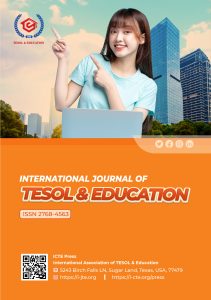 We are happy to let you know that Volume 5, Number 4, 2025 of the International Journal of TESOL & Education (IJTE) has been successfully finished and published. This issue adds to the growing body of research on English language education in Vietnam and the region. The studies in this issue help us learn more about classroom interaction, task-based pedagogy, disciplinary literacy, and research-oriented curriculum design.
The articles in this issue examine how teacher immediacy shapes students’ perceptions, how Task-Based Language Teaching can help students speak fluently, how conceptual metaphors shape financial discourse, and how the order of courses affects how students learn to write research papers. These works not only offer deeper theoretical insights but also highlight practical implications for educators, curriculum developers, and policymakers seeking to improve the quality of language education across contexts.
In this issue, Pham Hoang Dan (2025) examines differences in how teachers and students perceive nonverbal teacher immediacy in Vietnamese EFL speaking classes. Four educators and 138 first-year English majors filled out NIS questionnaires, and interviews were conducted with the teachers. Quantitative data were examined using SPSS t-tests and inter-rater reliability; interviews were analyzed thematically. Students rated teachers as moderately to highly immediate, whereas teachers’ self-assessments showed variability, with modest agreement and significant discrepancies in touch, proximity, gesture, and vocal expressiveness.
Pham Thanh Su (2025) examined the impact of Task-Based Language Teaching (TBLT) on speaking fluency among 28 A2-level, first-year non-English majors enrolled in a 10-week Foundation English course at a Vietnamese university. Classroom-based action research employed two structured observations utilizing a teacher fluency checklist and informal group discussions; the data were subjected to descriptive analysis. The results indicated increased speech rate, reduced pauses and repetitions, and students appreciating pre-task planning, collaborative activities, and meaning-centered communication, leading to reported improvements.
Nguyen Luu Diep Anh (2025) examines the manifestation of the conceptual metaphor “finance is fluid” in Vietnamese and English financial news. A dataset comprising 200 metaphorical expressions (100 for each language) is examined through Conceptual Metaphor Theory and MIP, integrating qualitative coding with frequency analysis. The findings indicate two prevailing models: “financial situation is the state of liquidity” and “supplying finance is supplying liquidity.” These models exhibit shared cognitive mappings while demonstrating culture-specific lexical selections and TESOL implications.
To investigate the influence of course sequencing on students’ perceptions of their research writing performance, Nguyen Hoang Quynh Anh and Dao Nguyen Anh Duc (2025) conducted a survey of 119 English Linguistics undergraduates at IU-VNU and interviewed four participants. A CIPP-based questionnaire was analyzed using Mann–Whitney U tests, while interviews were analyzed thematically. Students who took Research Writing after Research Methodology rated the goals, lectures, and assignments more favorably. This supports the idea that RM should precede RW to improve curriculum design and learning.
These four IJTE papers together provide a clear picture of what is most important right now in Vietnamese English-language education: communicative competence, disciplinary literacy, and research-oriented curriculum design. Pham Hoang Dan’s research indicates that although students typically perceive their teachers as nonverbally immediate, teachers’ self-perceptions do not consistently correspond, particularly regarding touch, proximity, gesture, and vocal variety. This highlights the necessity for reflective training in classroom interaction. Pham Thanh Su’s action research further substantiates that TBLT can significantly enhance speaking fluency for A2 non-English majors, with students appreciating pre-task planning, meaningful tasks, and collaboration.
Nguyen Luu Diep Anh’s contrastive analysis of the conceptual metaphor “finance is fluid” extends these concerns into ESP and disciplinary literacy, revealing shared cognitive mappings but language-specific realizations that have clear implications for teaching financial discourse. Lastly, Nguyen Hoang Quynh Anh and Dao Nguyen Anh Duc demonstrate that students who complete Research Methodology prior to Research Writing assess the latter more favorably, underscoring the significance of deliberate course sequencing for research readiness.
The papers collectively promote a learner-centered framework in which teacher conduct, task formulation, conceptual metaphor recognition, and curriculum organization synergistically enhance speaking confidence, deepen disciplinary comprehension, and strengthen research writing in Vietnamese higher education.
We are grateful to all of the authors for choosing IJTE as the place to publish their academic work and for their careful, thoughtful contributions. We also want to thank the universities and institutions they represent for their academic environments and support, which have enabled these research projects.
We appreciate the Editorial Board from the bottom of our hearts for their constant support, strategic vision, and hard work in maintaining the journal’s high academic standards. We also owe a lot to our reviewers, whose careful, helpful, and often unseen work has been very important in ensuring that every article in this issue is high-quality, clear, and honest.
We are excited to receive more submissions in the future and to keep working together to improve research in TESOL and education worldwide.
We are excited to receive more submissions in the future and to keep working together to improve research in TESOL and education worldwide.
Thanks be to God for everything!
Warm regards,
Associate Professor Dr. Pham Vu Phi Ho
Editor-in-chief
International Journal of TESOL & Education