
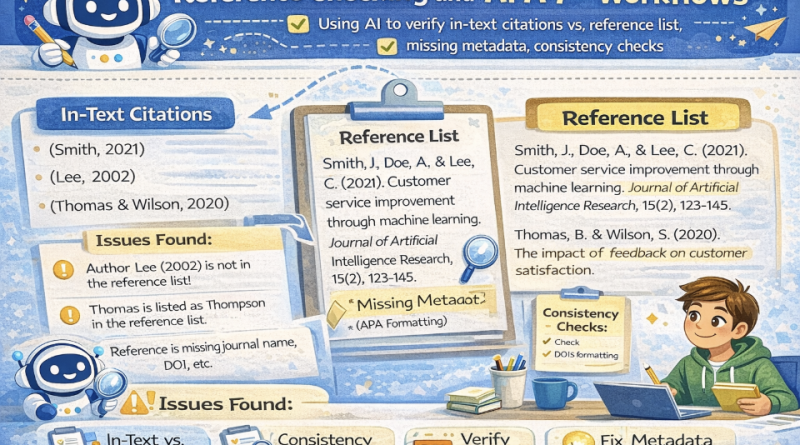
Reference Checking & APA 7th

Reference Checking & APA 7th
Use AI safely to verify in-text citations vs. reference list, detect missing items, find DOIs/URLs and missing metadata, and improve APA 7 consistency. Includes a Reference Audit Lab and an end-of-lesson problem-solving task.
Mic: Off
Tip: For best voice options, use Chrome/Edge. If voices don’t appear yet, click once on the page and wait 2–3 seconds.
1) Outcomes
By the end, you can…
- Check every in-text citation has a matching reference (and vice versa).
- Spot common APA 7 issues: author/year mismatches, missing DOI/URL, missing publisher, missing journal details.
- Use AI prompts for metadata completion (then verify in Google Scholar / publisher pages).
- Run a quick consistency audit before submission.
Safety rules (important)
- AI can suggest fixes, but you must verify DOIs and bibliographic details.
- Do not allow AI to invent references. Anything “found” must be confirmed.
- For final accuracy, cross-check with Google Scholar and the publisher page.
- Keep a revision log: what changed, why, and the source you verified.
Workflow: Extract in-text citations → normalize (author/year) → match to reference list → flag missing/unused →
check DOI/URL + missing metadata → fix formatting → final scan for consistency.
2) Conversation (APA Coach)
Build a safe AI workflow for APA 7 reference checking: scope, constraints, what to preserve, and verification steps.
Tip: Your prompts should explicitly forbid invention: “If you cannot verify a DOI, mark it unknown.”
3) Reading + Comprehension Quiz
Reading: Using AI for reference checking (APA 7) without losing accuracy
1 A common reason manuscripts are returned is inconsistent referencing. The fastest reliability improvement is to verify that
every in-text citation matches an item in the reference list, including author spelling and year. This also means the reverse:
every reference should be cited in the text unless it is intentionally included (e.g., a background bibliography, which is uncommon).
2 AI can help by extracting citation keys (author + year) and highlighting mismatches. However, AI should not be used to invent
missing references. When metadata is incomplete, a safe approach is to ask AI to list what is missing (DOI, journal issue, page range),
and then verify details using Google Scholar or the publisher’s official page.
3 APA 7 consistency checks include: correct author order, year format (including a/b for same-year works), correct title capitalization,
journal volume/issue, page range, and DOI format. For web sources, include a stable URL. For DOIs, APA prefers the URL form
(https://doi.org/…). A manuscript audit should prioritize correctness over “pretty formatting.”
4 A practical workflow is: (a) run a mismatch audit, (b) fix missing/unused items, (c) complete metadata, (d) standardize formatting,
and (e) do a final scan. Document changes so you can explain your process if reviewers raise concerns.
Comprehension check (choose the best answer)
4) APA 7 Toolkit (What to check)
Mismatch audit checklist
Metadata checklist (what’s often missing)
APA 7 quick rules (high-frequency)
DOI/URL checks
Worked mini example (common fixes)
5) Prompts + Examples (Copy & Adapt)
Use AI to identify problems and propose a plan. Then verify each DOI/metadata in Google Scholar or publisher pages.
Prompt 1 — In-text vs reference list audit
Prompt 2 — Missing metadata checklist + fill plan
Prompt 3 — DOI/URL verification workflow
Prompt 4 — APA 7 formatting standardization
Mini example (expected output structure)
6) Listening (Two Google Voices) — “AI checks, you verify”
Listen to two editors discussing APA 7 consistency and DOI verification. Then answer the questions.
7) Reference Audit Lab (Paste → detect mismatches)
Paste (A) your manuscript text (or a section) and (B) your reference list. This tool will:
extract (Author, Year) from in-text citations, match to references, flag missing/unused items,
and check for DOI/URL presence and some common missing metadata.
A) Manuscript text (in-text citations)
Tip: Include the section where most citations appear (literature review).
B) Reference list (APA 7)
Tip: Separate entries by blank lines to improve detection.
Audit report
Safe AI prompt (to fix issues after you audit)
8) Problem-solving
Scenario: You are submitting a paper. The editor reports:
- Several in-text citations have no matching references.
- Several references are never cited in the manuscript.
- Multiple references are missing DOI/URL or key fields (volume/issue/pages).
- Some author/year pairs differ (e.g., 2020 in text but 2019 in list).
A) Fix plan (5–8 bullets)
B) Verification steps (3 bullets)
C) One corrected APA 7 reference (include DOI/URL if known)
Progress
0
Activities completed
0%
Average score
0
Checklist items used
Saved locally in your browser (local storage).