
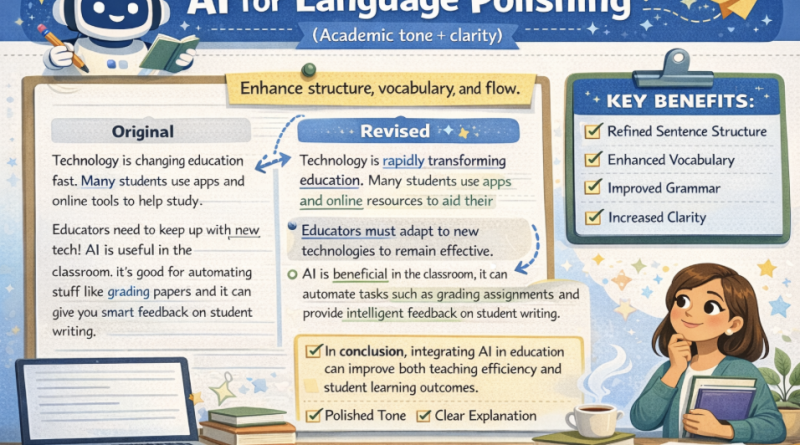
AI for Language Polishing
AI for Language Polishing
Learn to use AI for paraphrasing vs. rewriting, reducing redundancy, improving cohesion, and avoiding “AI-sounding” prose. Includes a reading text, MCQ quiz, examples, and a two-speaker Google Voices listening dialogue.
Mic: Off
Tip: For best voice options, use Chrome/Edge. If voices don’t appear yet, click once on the page and wait 2–3 seconds.
1) Conversation (Polishing Coach)
You will build a safe, effective polishing prompt step-by-step. Target outcomes: clarity, academic tone, less redundancy, and natural voice.
Coach tip: Always tell AI what to preserve (meaning, citations, terminology) and what to avoid (fabrication, inflated claims).
2) Core Concepts (Quick Guide)
Key distinction: Paraphrasing = same meaning, new wording, similar scope. Rewriting = restructure and improve logic/flow.
Paraphrasing (use when…)
- You need a different phrasing but the same meaning and scope.
- You must keep the original claim strength (no exaggeration).
- You must keep key terms (constructs, variables, technical labels).
Rewriting (use when…)
- Your sentence order is unclear or repetitive.
- You need stronger cohesion (topic sentences, transitions, pronoun clarity).
- You want a more academic, concise, readable paragraph.
Reduce redundancy (common targets)
- Duplicated meaning (e.g., “each and every,” “basic fundamentals”).
- Filler phrases (e.g., “it should be noted that,” “in order to”).
- Over-hedging or stacked qualifiers (e.g., “somewhat relatively quite”).
Improve cohesion (tools)
- Clear topic sentence → supporting points → concluding link.
- Controlled transitions (However, Therefore, In contrast, For example).
- Reference clarity (avoid “this/it/they” with unclear antecedents).
Avoid “AI-sounding” prose (red flags)
- Overly symmetrical sentences and repeated templates.
- Generic intensifiers (e.g., “crucial,” “significant,” “ever-evolving”) without evidence.
- Long, inflated noun phrases (“the utilization of… in the context of…”).
- Too many transitions (“Moreover,” “Furthermore,” every sentence).
- Vague claims (“This suggests that…”) without specifying what and why.
- Unnecessary disclaimers (“It is important to note that…”).
3) Reading + Comprehension Quiz
Reading: Using AI to polish academic writing (without losing your voice)
1 AI can help polish academic writing, but it should be used as an editing assistant, not as the author.
A safe approach is to give AI a clear task, set boundaries, and then evaluate the output with your own judgment.
When used carefully, AI can improve clarity, reduce repetition, and suggest smoother transitions.
2 A key skill is knowing the difference between paraphrasing and rewriting.
Paraphrasing keeps the same meaning and scope but changes wording.
Rewriting is deeper: it may reorganize sentences, improve logic, and strengthen cohesion.
In research writing, paraphrase carefully so you do not change the strength of a claim or misrepresent a source.
3 Good polishing removes redundancy.
Redundancy often appears as repeated ideas across sentences, unnecessary filler phrases, or wordy expressions.
For example, “in order to” can often become “to,” and “due to the fact that” can become “because.”
Shorter does not always mean better, but clearer usually means fewer unnecessary words.
4 Another focus is cohesion.
Cohesion is how sentences connect so the reader can follow the argument.
Polishing may involve adding a clearer topic sentence, replacing vague pronouns, or using transitions sparingly.
Effective cohesion makes the paragraph feel like one connected idea rather than a list of separate statements.
5 Writers should also avoid “AI-sounding” prose.
This style often includes inflated vocabulary, generic claims, and too many transitions.
A practical strategy is to ask AI for two versions: one very concise and one more detailed,
and then choose the best parts to revise manually.
Finally, never ask AI to invent citations; keep references unchanged unless you verify them yourself.
Comprehension check (choose the best answer)
4) Examples (Paraphrase vs Rewrite vs Polish)
Use rule: If you are working from a source, paraphrase responsibly. If you are improving your own draft, rewrite/polish.
Original (student draft)
A) Paraphrase (same meaning, new wording)
B) Rewrite (restructure for logic + flow)
C) Polish (academic tone + clarity, less redundancy, better cohesion)
“AI-sounding” → more natural academic voice
Prompt templates (copy & adapt)
5) Listening (Two Google Voices) — “Polish without changing meaning”
Listen to two researchers discussing paraphrasing vs rewriting and “AI-sounding” style. Then answer the questions.
6) Polishing Lab (Build a strong editing prompt)
Paste a paragraph, choose a polishing goal, and generate a safe prompt you can use in any AI tool.
Keep citations and meaning unchanged.
A) Paste your paragraph
Tip: If this is from a source, label it as “source-based” and ask AI to keep claim strength unchanged.
B) Choose your goal
Generated prompt (copy into your AI tool)
Progress
0
Activities completed
0%
Average score
0
Safety checks used
Saved in your browser (local storage). Switching browsers/devices resets progress.